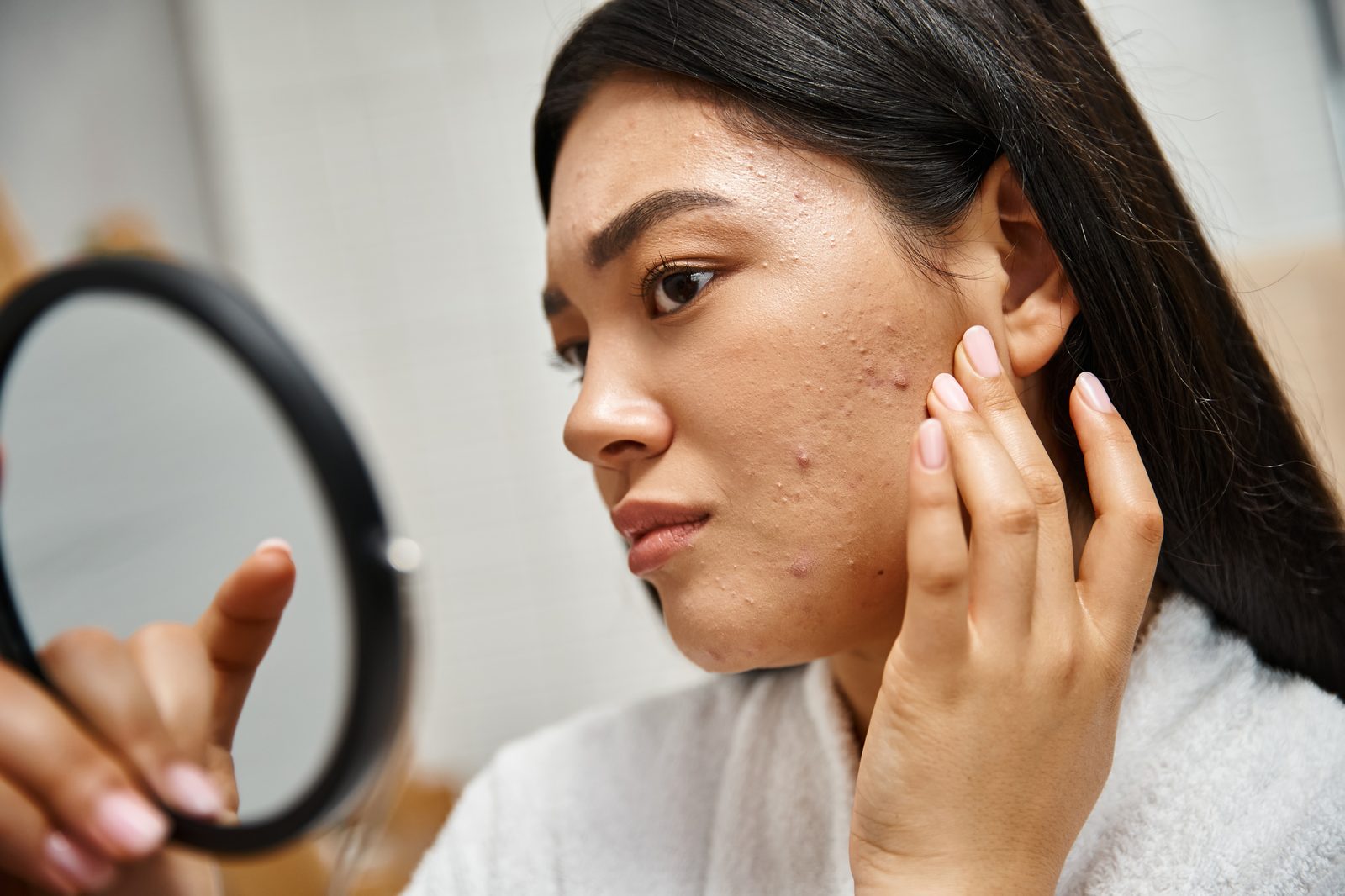
Short answer. You often cannot tell skin purging from a breakout by looking in the mirror. A 2009 review in the Journal of Drugs in Dermatology found no clinical trial data showing that starting a topical retinoid makes acne flare (PubMed). So handle new spots the same way: change one thing at a time and ask a pharmacist or dermatologist.
Oleah helps you see the pattern instead of one mirror glance. You add the products in your routine and take a quick face scan each morning, which takes about 30 seconds. Then you look at the check-in on day 3 and the reports on day 7 and day 14.
Published 26 October 2026. Last updated 26 October 2026. Sources checked 24 October 2026. Written by the Oleah team from the sources listed below.
What is skin purging?
Purging is a word people use for new spots that appear after starting an active ingredient such as a retinoid or an acid. It is a popular term, not a medical one. The review authors wrote that existing dogma holds that topical retinoids may initially worsen acne. They found no primary trial data to support it (PubMed).
Purging vs breakout: how do they compare?
The honest answer is that the two can look the same. This table puts what the sources say side by side.
| What people call purging | A breakout from a product | |
|---|---|---|
| When people notice it | After starting a retinoid or an acid | After any new product, including a moisturiser or makeup |
| What the sources say | A review found no trial data that retinoids make acne flare (PubMed) | The AAD says oily makeup and skin care products can make acne worse (AAD) |
| What to do | Keep to one change at a time and ask a pharmacist or dermatologist | Look at the label and ask a pharmacist or dermatologist |
What does the evidence say?
"It is unlikely that acne worsens or 'flares' due to the initiation of topical retinoids." Brad A. Yentzer and colleagues, Journal of Drugs in Dermatology, 2009, via PubMed
For your routine, this means a new spot is not proof that a product is doing its job. It is a reason to slow down and ask.
Can switching products cause new spots?
Yes, it can. The American Academy of Dermatology (AAD) says using a different product every few days can irritate your skin and cause new breakouts (AAD). The AAD also says some products labelled non-comedogenic may still cause acne in a few people (AAD).
What should you do if a new product brings spots?
- Check for a reaction. The AAD says that if you get a skin reaction, such as red, itchy or swollen skin, wash the product off gently and do not use it again (AAD). The AAD also says to stop using a product that stings, burns or tingles (AAD).
- Change one thing at a time. The AAD quotes dermatologist Marisa Garshick saying to introduce one new product at a time (AAD).
- Keep the rest of your routine the same. Then you know which product is new.
- Follow it in Oleah. Add the products in your routine and take a quick face scan each morning. Look at the day 3 check-in, the day 7 report and the day 14 report instead of one mirror glance.
- Do not pick or squeeze. The NHS says picking or squeezing spots can cause scars (NHS).
- Ask a pharmacist or dermatologist. The NHS says a pharmacist can help with acne (NHS).
When should you see a doctor?
The NHS says to see a GP if spots are deep, painful or causing scars, or if what you tried yourself has not helped (NHS). If a product stings, burns or makes your skin red, wash it off and stop using it. If a doctor prescribed it, ask them first. If your skin stays sore, see a pharmacist or doctor. If it blisters or swells, see a doctor today. If your lips, tongue or throat swell, or you have trouble breathing, call emergency services now. Oleah is not a doctor and does not give medical advice.
How to check this on your own shelf
Oleah is an iPhone app for the skincare you already own. You add the products on your shelf or in your routine, and each morning you take a quick face scan that takes about 30 seconds. Oleah can flag products on your shelf that may not belong together. There is a check-in on day 3, a report on day 7 and a report on day 14. Oleah is not a doctor and does not give medical advice.
Download the free iPhone beta. Add the products on your shelf, then take a quick face scan in the morning.
Related: How to know if skincare is working and how do you start using retinol.
Questions people ask
Is it purging or breaking out? You often cannot tell by looking. A 2009 review found no trial data that starting a topical retinoid makes acne flare, so ask a pharmacist or dermatologist about any new spots.
How long does skin purging last? There is no trial figure for it. A 2009 review found no trial data showing that starting a topical retinoid makes acne flare. For an acne product, the AAD says to expect some improvement in 4 to 6 weeks. It says clearing can take two to three months or longer.
Does retinol cause purging? Many people say so, but a 2009 review in the Journal of Drugs in Dermatology found no primary trial data to support it.
Should I stop a product if I break out? Stop it if your skin gets red, itchy or swollen, as the AAD advises. For spots alone, keep the rest of your routine the same and ask a pharmacist or dermatologist.
Can a new moisturiser cause breakouts? It can. The AAD says oily skin care products and makeup can make acne worse.
Sources
- Yentzer BA et al., "Do topical retinoids cause acne to flare?", Journal of Drugs in Dermatology, 2009. https://pubmed.ncbi.nlm.nih.gov/19746671/. Accessed 24 October 2026.
- American Academy of Dermatology, "Acne: Who gets and causes". https://www.aad.org/public/diseases/acne/causes/acne-causes. Accessed 24 October 2026.
- American Academy of Dermatology, "9 things to try when acne won't clear". https://www.aad.org/public/diseases/acne/diy/wont-clear. Accessed 24 October 2026.
- American Academy of Dermatology, "How to test skin care products". https://www.aad.org/public/everyday-care/skin-care-secrets/prevent-skin-problems/test-skin-care-products. Accessed 24 October 2026.
- American Academy of Dermatology, "A dermatologist's guide to skincare from growing up to glowing up", 28 October 2025. https://www.aad.org/news/dermatologist-guide-skincare. Accessed 24 October 2026.
- American Academy of Dermatology, "How to maximize results from anti-aging skin care products". https://www.aad.org/public/everyday-care/skin-care-secrets/anti-aging/maximize-anti-aging-products. Accessed 24 October 2026.
- NHS, "Acne". https://www.nhs.uk/conditions/acne/. Accessed 24 October 2026.
Oleah tracks how your skin looks. It is not a medical device. See a doctor about skin conditions.